Play Tic-Tac-Toe Online
One Miss Is Enough
Most tic-tac-toe games end after only a handful of moves. The mistake that decides the game usually comes before the final line: a late block, a center given away too easily, or a double threat spotted only after both winning squares are open. With perfect play, neither side can force a win. If you can see how that draw is held, you understand more than the win condition.
Check the Board Before You Tap
Before choosing a square, scan the three rows, three columns, and two diagonals. Finish your own three if you can. Otherwise, block any square that lets your opponent win next turn. Both checks come before any positional plan.
If neither side can win immediately, look for a move that leaves two separate winning squares. That double threat cannot usually be stopped in one turn. The same test works in defense: once both squares are open, blocking either one is already too late.
Why the Center Matters
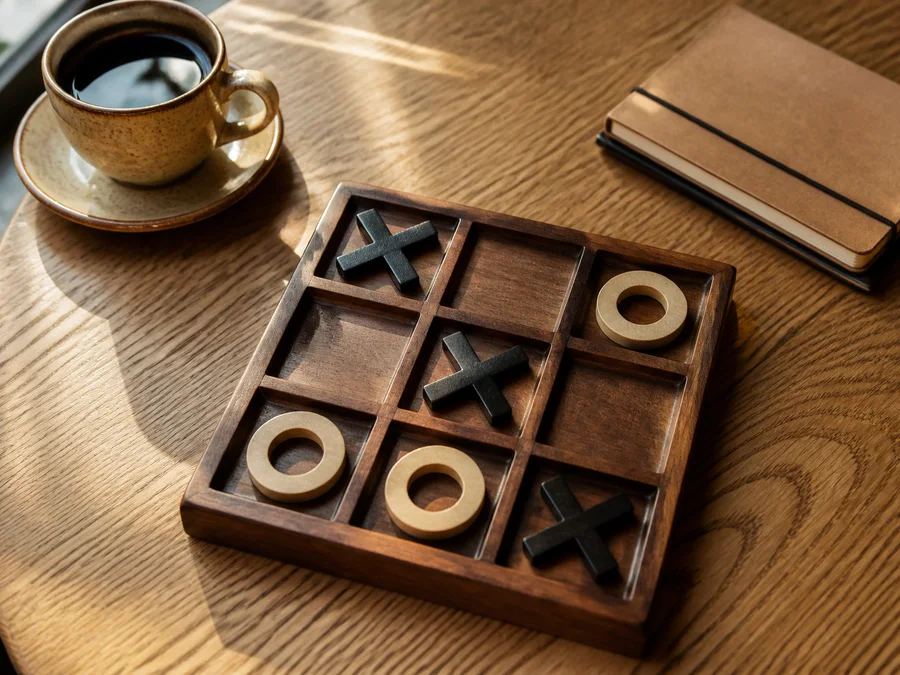
The center belongs to four winning lines, each corner to three, and each edge to two. On an empty board, the center keeps the most routes open. It is not an automatic choice later: an immediate win or forced block comes first. If the other player opens in the center, a corner covers more useful lines than an edge.

The Losing Move Comes Earlier
The final winning square is often impossible to stop. In review, go back to the move that opened two lines at once. A common trap appears when the opponent holds opposite corners and you hold the center; taking an edge prevents the corner double threat. Do not ask which final line to block. Ask where both threats first became possible.
Pick the Right Mode
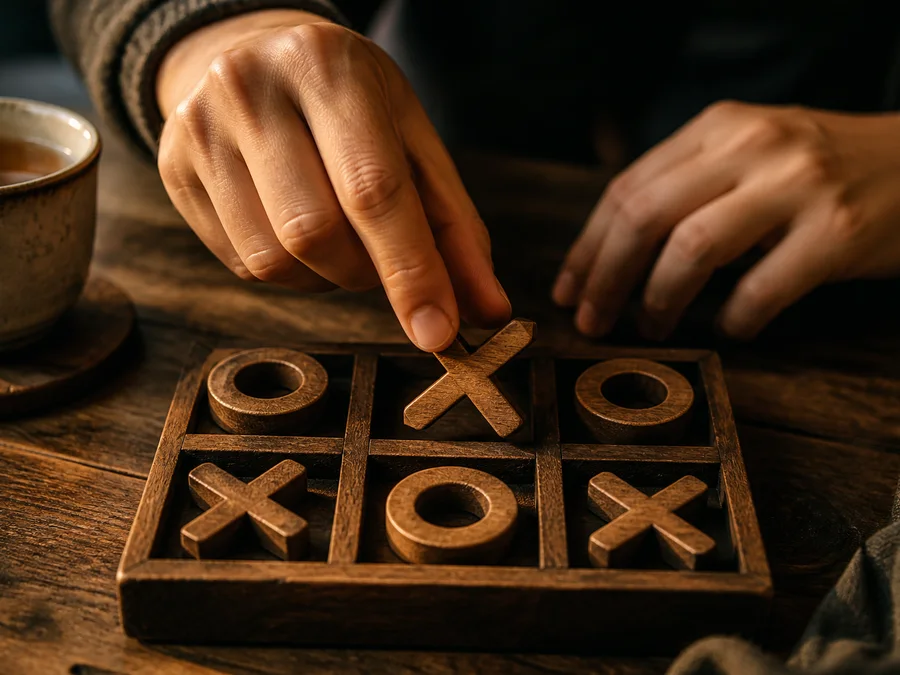
Use AI play when you want to repeat an opening and compare candidate moves with hints, undo, and replay. When two players are in the same room, put one device between them and swap who controls X after each game. For a remote game, create an online room and send the link. The board and rules stay the same in every mode, and X always moves first.
3×3nine squares
8winning lines
4winning lines through center
Drawresult of perfect play
Common questions
How do you win, and when is a game a draw?
You win when your marks fill any row, column, or diagonal of three. The game ends at once, even if empty squares remain. A draw happens only when all nine squares are filled and nobody has three in a row. If the ninth move completes a line, that side wins; it is not scored as a draw.
Why does perfect play always end in a draw?
From an empty board, neither side can force a win if both players catch every immediate win, every forced block, and every true double threat. The board fills, and the game is drawn. Real games still go one way or the other when someone misses a beat—not because the rules favor X or O.
Does the first move have to take the center?
No. The center sits on four winning lines, so it is often a steady opening on an empty board, but X may start on any empty square. A corner can also hold a draw with best play. Once a forced win or block appears, answer that first instead of grabbing the center out of habit.
What is a double threat, and why can't one move stop it?
A double threat leaves two different squares that each complete three in a row. Block one, and the next move wins on the other. If two lines share the same missing square, one block covers both—that is not a true fork. The real mistake is usually earlier: letting both threats open at once.
How should I use hints, undo, and replay without just copying the answer?
Pick a square yourself first, and say whether it wins, blocks, or builds a double threat. Then open the hint and compare. A hint is one candidate among equals when several moves score the same. Undo takes you back to the fork so you can try another idea. Replay is for finding where a forced move was missed, not only for watching the final three-in-a-row.
Can I play without an account or an app?
Yes. Open the page on a phone or computer and tap a square. There is no account, email, or password. Adding the site to your home screen is optional, and a full game works without installing anything.
Can I choose to play as X or O?
Against the AI, yes. As X you move first. As O the AI plays the opening mark. Switching sides mid-game starts a new game, and marks already played do not stay. In an online room you pick your side when you create it. Two players on one device do not choose sides: X moves first, and you take turns.
If I close the page and open it again, is this game still there?
Games against the AI, and games on one shared device, stay in this browser. Closing the tab and coming back usually resumes where you left off. Clearing this site's data usually removes those unfinished games. An online room uses the room link and a reconnect token to restore your seat; after a device or browser change, the same link alone often cannot reclaim that seat.
If I invite a friend online, can I undo and use hints the way I can here?
No. Once an online room accepts a move, that move is sent to the other player. There is no hint and no one-sided undo. You can resign, or offer a draw that only counts if the other player accepts. If the connection drops, opening the page again in the same browser usually brings you back to the same room.
How is two players on one device different from playing the AI?
Two people share one device and take turns face to face. You do not need a network connection, and neither side gets a hint. Undo and replay are still there, so you can stop and talk through a move. Multiple AI levels are available only when you play the computer, which is the mode for repeating the same opening until the line is clear.